


Is Bakuchiol Good for Sensitive Skin?
Bakuchiol · Sensitive skin · A gentler ritual
A little renewal.
A little more comfort.
Curious about bakuchiol for sensitive skin? Start with what it can offer, what your skin already tolerates, and a routine with room to breathe.
Bakuchiol can be a good option for some people with sensitive skin, particularly when retinol has caused flaking or stinging. Early research is encouraging, but comfort depends on the finished formula and how your skin responds.
If you have ever set aside a serum because your skin felt tight by morning, you know the appeal of a gentler approach. You want to address fine lines or uneven-looking tone while keeping the everyday pleasure of your routine.
That is where bakuchiol deserves a closer look. Begin with a little curiosity, a careful ingredient check, and permission to go slowly.
01 / Get to know the ingredient
What does bakuchiol do?
Bakuchiol is a plant-derived ingredient used in skincare aimed at the appearance of fine lines and uneven pigmentation. Often called a retinol alternative, it is a different ingredient from retinol.
In a small, 12-week randomized study of 44 people, both 0.5% bakuchiol cream and 0.5% retinol cream improved wrinkles and pigmentation. Retinol users reported more scaling and stinging. Bakuchiol was applied twice daily, while retinol was used once daily. Read the clinical study →
That finding is promising, but it does not establish that every bakuchiol product works like retinol or suits every sensitive complexion. It also does not tell us that a higher percentage will deliver better results.
This may be your match if…
Your skin feels settled, you want to address fine lines or uneven-looking tone, and you would like to explore an alternative to a retinol you found uncomfortable.
02 / Read beyond the front label
The right ingredient needs the right formula.
Sensitive skin has its own history. Perhaps fragrance has bothered you before. Perhaps your cheeks feel dry while your T-zone prefers something light. Those details are useful when choosing a new product.
If your skin feels dry
Look for a moisturizer base you enjoy, with ingredients such as glycerin, ceramides or squalane. A treatment cream may fit more easily into your routine than adding another serum.
If you prefer lighter layers
A serum can fit before a moisturizer you already trust. Check the directions and ingredient list, including any fragrance or essential oils.
If fragrance is a known trigger, prioritize a fragrance-free formula. Botanical ingredients and “natural” claims do not guarantee tolerance. The American Academy of Dermatology’s product-testing guide explains why that distinction matters.
And if your usual moisturizer stings or your skin feels raw, let a new active wait. Return to gentle basics you tolerate; persistent burning, redness or flaking deserves professional advice.

03 / Ease into your evening
How to use bakuchiol on sensitive skin.
One new formula. Enough time to listen.
- Test a small area first. The AAD recommends testing a new skincare product on a small area twice daily for seven to ten days before wider use. Follow the product’s directions, and stop if a reaction develops. See the testing steps.
- Introduce it gradually. If the label allows, begin on two evenings a week. Keep that pace while you assess comfort; increase only if your skin tolerates it.
- Keep the surrounding routine simple. Cleanse gently, apply a serum before moisturizer or use a bakuchiol cream as your moisturizing step, following its label. Leave exfoliating acids and other new treatments out while you assess the formula.
- Protect your skin the next day. Use broad-spectrum SPF 30 or higher, choose water resistance when appropriate, and follow reapplication directions. Read the AAD’s guidance.
For help fitting a treatment into the steps you already use, explore our skincare layering guide.
A Calgary consideration
Let comfort set the pace.
If colder weather and indoor heating leave your skin feeling tighter, give your moisturizer more attention. Your routine can change with the season; there is no need to increase an active while your skin is asking for a pause.
04 / The product edit
Two formats to explore.
For a moisturizer step
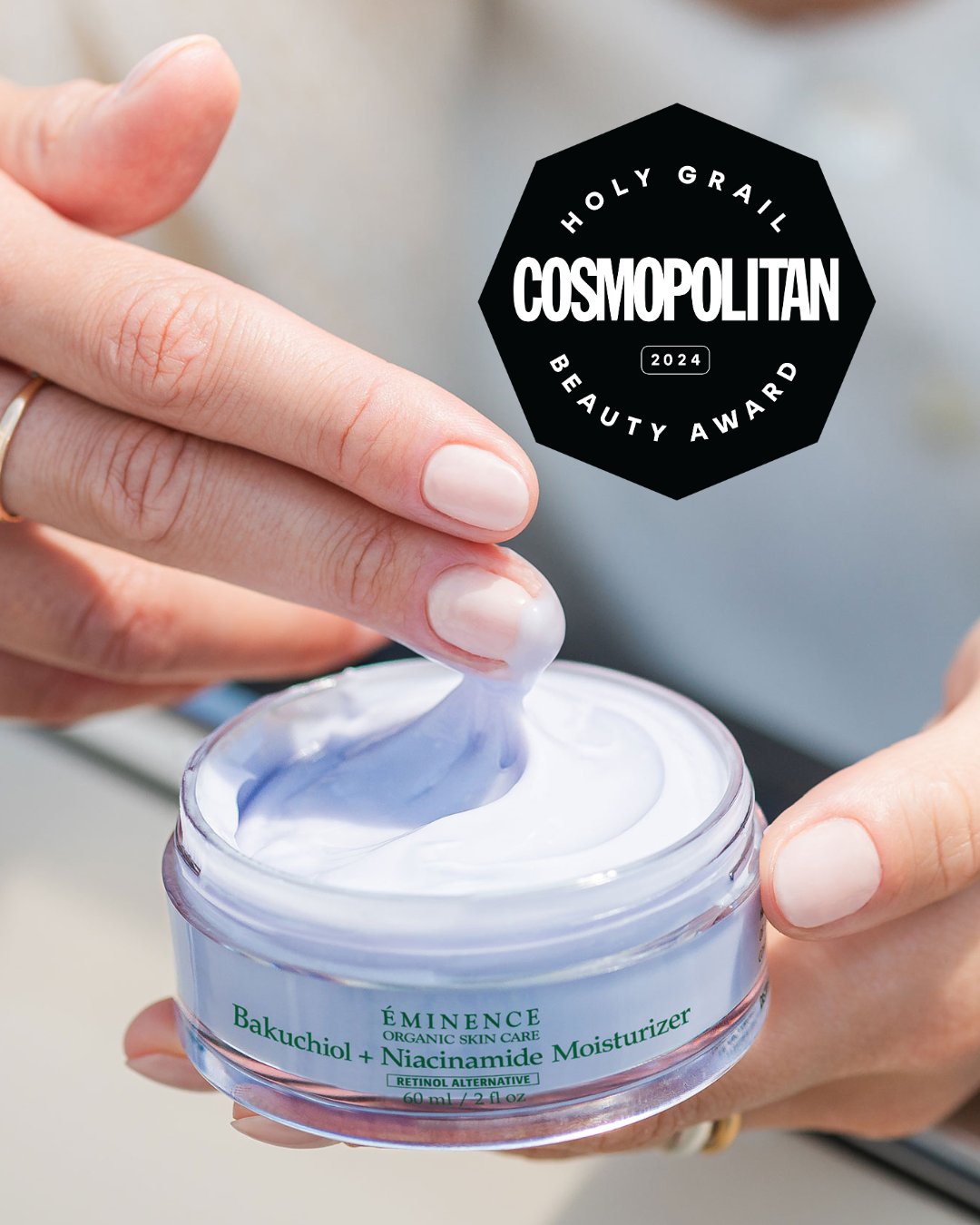
Éminence Bakuchiol + Niacinamide Moisturizer combines bakuchiol, niacinamide and provitamin B5 in a lightweight gel-cream. It contains fragrance, limonene and linalool, so it may not suit someone who reacts to scented skincare.
For a separate serum step
Three Ships Skin Hero Calendula + 2% Bakuchiol Bio-Retinol Serum is directed for evening use before moisturizer. Its listed ingredients include bitter orange peel oil and limonene; consider those if fragrance ingredients have bothered your skin.
Choose one format to begin. Neither is a universal sensitive-skin recommendation, and you do not need both to build a bakuchiol routine.
05 / Give it time
What results should you expect?
Think in weeks rather than overnight transformations. The clinical trial assessed changes over twelve weeks; your results will depend on the formula, consistency and your skin. A moisturizing base may feel comforting sooner, but that is different from a visible change in pigmentation or fine lines.
Comfort is worth checking from the start. Persistent stinging, itching or redness is a reason to stop and reassess. You do not need to push through irritation to earn a result.
Before you begin
A few things you might be wondering.
Is bakuchiol better than retinol for sensitive skin?
It may be easier to tolerate for some people. The small comparison study reported more scaling and stinging with retinol, but your response still depends on the complete product. Bakuchiol is not an automatic substitute for prescribed treatment.
Can sensitive skin use bakuchiol every day?
Some formulas are intended for daily use. Introduce yours gradually, follow its directions and let your skin’s response guide frequency. More frequent use is not a goal if your skin becomes uncomfortable.
Does bakuchiol help with dryness and redness?
Choose the moisturizer base for hydration. Bakuchiol’s photoageing research does not establish it as a treatment for persistent redness, eczema or rosacea. Those concerns may need tailored advice.
Can I use bakuchiol with exfoliating acids?
While introducing it, keep acids out of the same routine so it is easier to assess tolerance. If you later use both, separate evenings may be more manageable. Follow each product’s directions.
Does “bio-retinol” always mean bakuchiol?
No. Check the ingredient list for bakuchiol rather than relying on the product name. Different formulas use different ingredients under the retinol-alternative label.
Find your ritual
A little guidance makes it personal.
Bring us your current routine, the textures you enjoy and the ingredients you already know your skin dislikes. We can help you compare formulas and find a considered next step.
Explore our skincare edit online or visit Oak + Tonic in Calgary. Still weighing your options? Our guide to retinol alternatives is a helpful next read.
Explore your next ritual →


Leave a comment